Animation Comes to the Labyrinth
· design, systems, meta
Every figure in the Labyrinth is a single painting. One hero, ninety-eight things that want him dead, a handful of townsfolk who mostly don't. They turn to face you, they lunge a little when they strike, and otherwise they stand there like what they are: pictures of monsters. This week I started teaching the pictures to move.
First, the plain part: this is a preview of an upcoming build. The build you can download today has not changed. Nothing below is in your hands yet.
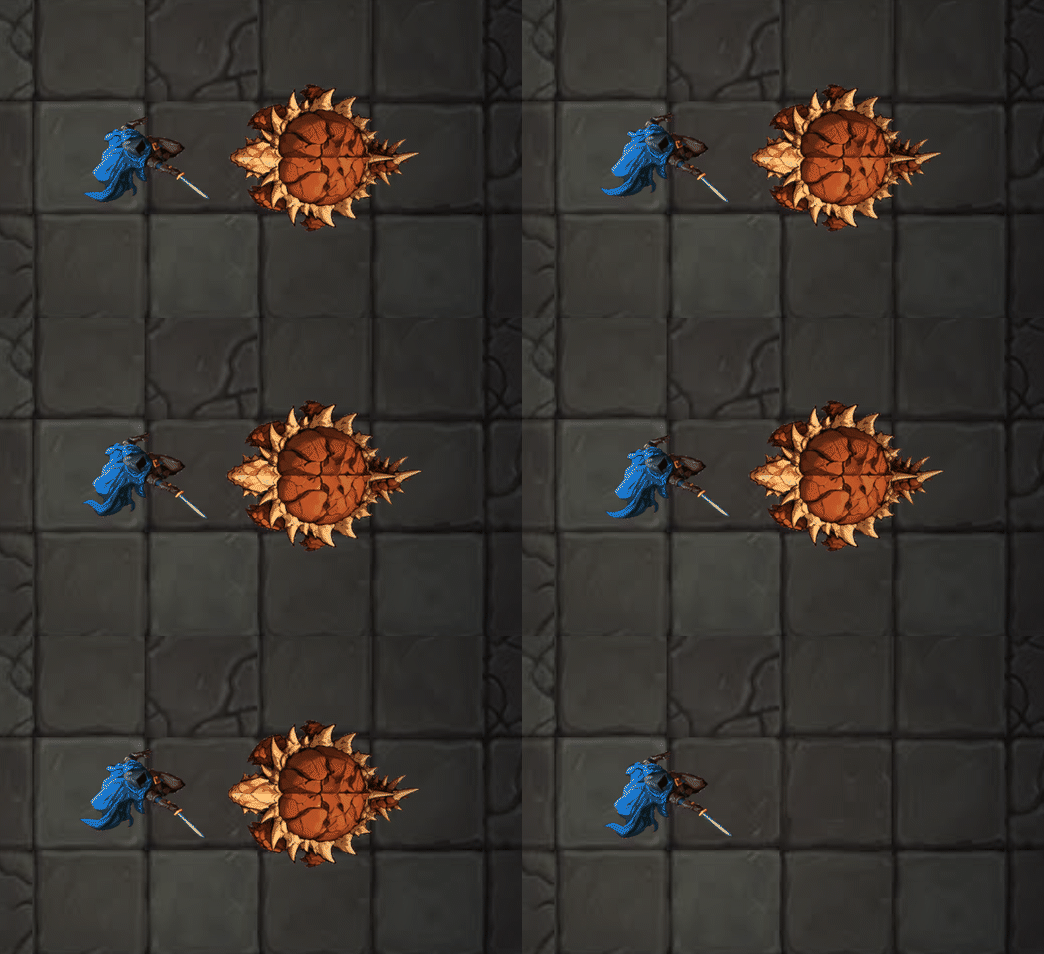
That's the hero and the Tarasque. Both wait, it bites, he answers, it dies. Nothing in that clip is a new drawing.
One painting, bent on purpose
I'm not much of an artist, and nobody is hand-animating a hundred and seven figures for a one-person roguelike. I did consider generating frames, a little strip of poses for every creature. A hundred and seven figures, four states each, eight facings: I'd have spent the winter sorting pictures of goblins, and they'd never have quite matched the originals.
So the animation is code. Each figure keeps its one painting, and a small recipe pulls on it: breathe here, swing this about the shoulder, recoil, sag, fade. Four states to start: waiting, attacking, being hit, and dying. The same recipe holds for all eight facings, and the torchlight still falls on it the way it always did.
Building the workshop
The game was the wrong place to work this out, so I built a separate small workshop beside it, the way I did for combat and for level generation. It reads the same paintings the game uses, lays down the same catacomb floor, and lights it with the same torch, so what I approve there is what you'll see in the dark.
The first version didn't survive contact with the engine. My plan was to push a painting's outline around directly, and Unity refused, flatly, in one line of red text. The version that works stretches each painting over a fine grid and moves the grid. That took a day I hadn't planned on, and one bad hour where I had a moving monster that the torchlight ignored completely.
The loop it runs is simple. One creature at a time, it puts several versions of each state side by side. I pick the one that feels right, drag a few sliders, and write a note about what's wrong. A fresh batch comes back shaped by the note. When all four states have a winner, I sign off, and the result is a short list of numbers, so the same creature moves the same way every time. Then the workshop stages a fight, with the game's own lunge and flinch on top, so I'm judging the thing in a brawl and not on a pedestal.
Things I had to be told by my own eyes
The first hero attack I approved of for about four seconds. Then I noticed the sword flexing like a pool noodle. Swords don't bend. Neither do spears, shields, helms, or the rock the brute is holding over its head. They are rigid pieces now, and they swing from the joint that holds them.
The spider taught me the same lesson eight more times. Well, ten: I counted the legs in the painting, and my spider has ten. It is staying that way. Each leg is a stiff bar hinged at the hip, and when it scuttles on the spot waiting for you, it is exactly as unpleasant as I hoped.
Subtle idles turned out to be invisible idles. At the game's zoom, a figure breathing two percent is a figure standing still. Everything got bolder.
Where it stands, and where it's going
Five figures have animations I've signed off on: the hero, the grunt, the hobgoblin, the brute and the ooze. The Tarasque above is a first draft I haven't finished arguing with. That leaves about a hundred.
The plan from here, in order:
- The rest of the bestiary, a family at a time, about eight creatures a sitting. The bosses get the most care. They've earned it.
- Wiring it into the game. The workshop only saves the numbers. The game still has to learn to play them: the idle while a creature waits its turn, the strike when it swings, the flinch when you land one, the collapse when it dies.
- More states, once those four are solid: moving, casting, sleeping, and a wounded idle for things that are nearly dead and know it.
- A way to turn it down. The reduce-flashes-and-shake setting will get a companion for motion, for anyone who'd rather the dark held still.
Until that lands, the current build is the one you already have, where everyone stands very still and kills you anyway.
What's next
More monsters through the workshop. I'll show the ones that come out well. I'll probably show the ones that don't, too. They're funnier.